In Santa Cruz de Tenerife, the first Spanish edition crowned two books for the jury prize, while students across the Canary Islands chose Con algoritmos y a lo loco.
The Premio Cosmos arrived in Spain this year, organised by the Instituto de Astrofísica de Canarias. On 16 June, the winners were announced at the Auditorio de la Fundación CajaCanarias in Santa Cruz de Tenerife.
The scientific committee, which met in Madrid to deliberate, could not separate two books. The prize is shared by José T. López Gómez, for his account of the largest mass extinction in Earth’s history, and Lise Barnéoud, for her exploration of microchimerism, the cells that travel between mother and child.
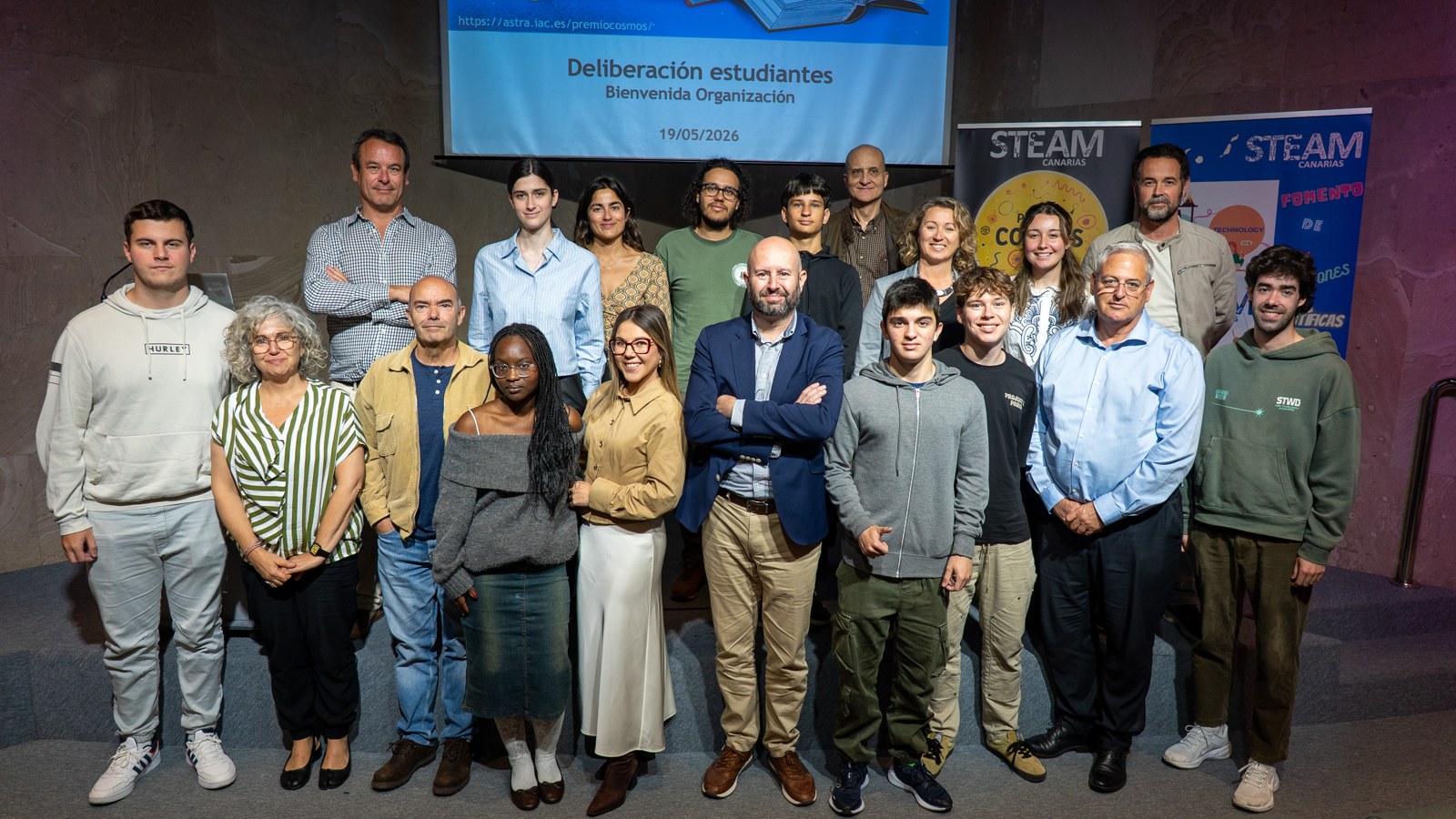
The students’ prize went to mathematician Clara Grima. Secondary school students from across the Canary Islands read four finalists and met on 19 May to choose their winner. A prize for the best student video went to IES Marina Cebrián.
The new edition was made possible with the support of the Fundación CajaCanarias, the Real Academia de Ciencias Exactas, Físicas y Naturales, the Canary Islands education department and the Cabildo de Tenerife.
The winning books
- Premio Cosmos (joint): La vida al borde del abismo. La mayor extinción conocida de la Tierra, José T. López Gómez (Catarata)
- Premio Cosmos (joint): Las células errantes. La increíble biología del microquimerismo, Lise Barnéoud, translated by Belén Gala Valencia (Alianza)
- Premio Cosmos Estudiantes: Con algoritmos y a lo loco. Porque no son tan malos como parecen, Clara Grima (Ariel)
The other student finalists: Jonathan Benito, El poder de la amabilidad (Planeta); Enrique Nácher and Sergio Pastor, La formación de los elementos químicos (Catarata / CSIC); Alain Riazuelo, Por qué la Tierra es redonda, translated by Miguel Paredes Larrucea (Alianza).
The student jury on deliberation day, May 2026. Photo: IAC